Intelligence · Long-form Report
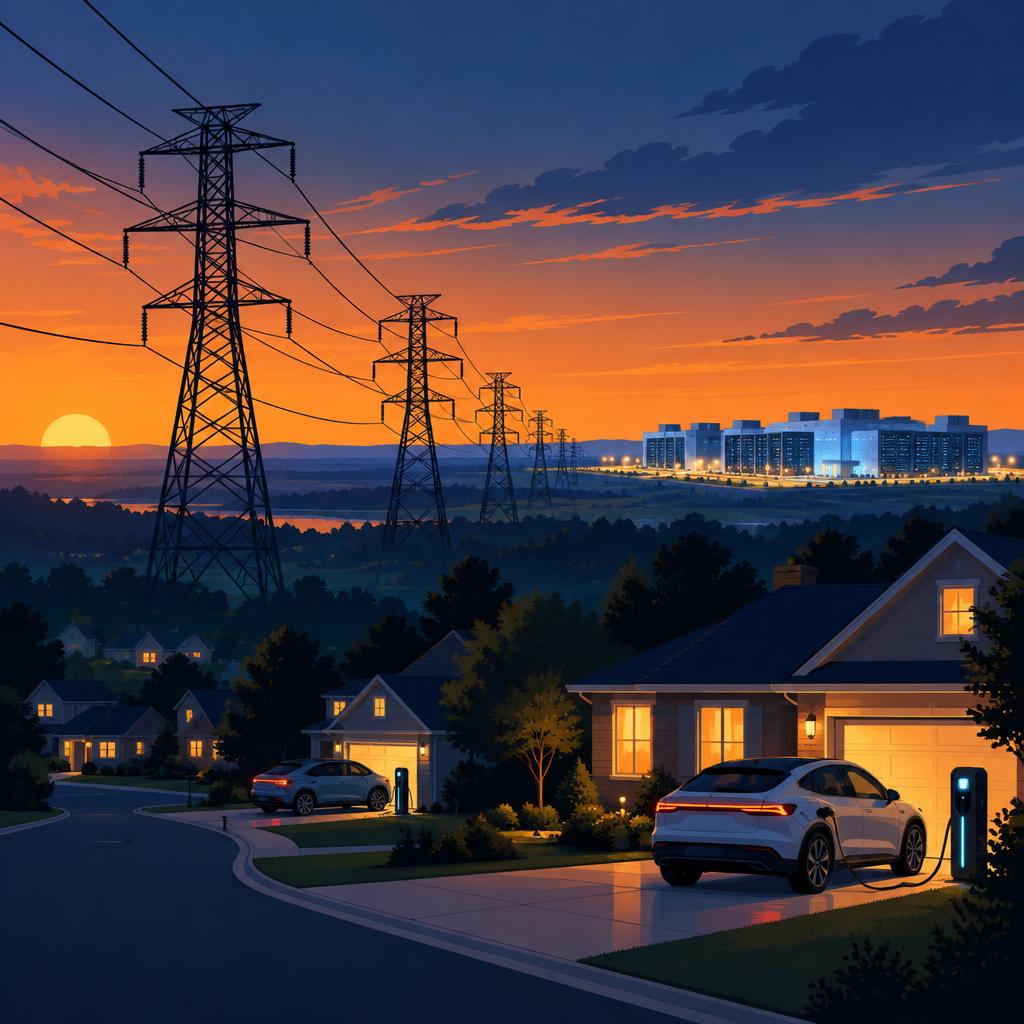
Why America's Electricity Grid Is Struggling to Keep Up With the AI and EV Boom
After two decades of almost flat demand, US electricity use is setting records. Data centers, electric vehicles and new factories are arriving faster than power plants and transmission lines can be built, and the strain is showing up in capacity auctions, interconnection queues and household bills. A source-led look at what the grid data actually says.
Independent coverage
Robotics Correspondent · Trondheim, Norway
Published 21 November 2026
13 min read
Evidence: Analysis
For roughly two decades, American electricity demand barely moved. Utilities planned around efficiency gains that cancelled out growth, and the grid's biggest problems were aging equipment and extreme weather. That era is over. The Energy Information Administration now expects US electricity generation to grow 2.2 percent to a record 4,368 billion kilowatt-hours in 2026, with another 1.7 percent in 2027, driven particularly by data center development and new manufacturing in the West South Central region. Two percent annual growth sounds modest. For a system built around flat demand, it is a regime change.
Three forces are converging on the same wires: artificial intelligence data centers, electric vehicles, and industrial onshoring. Each would be manageable alone. Together, they are arriving faster than the institutions that build power plants, approve transmission lines and set electricity rates were designed to handle. This report walks through what the data shows, where the strain is most visible, and what it means for households and businesses. It is a companion to our report on the power, financing and construction challenges facing US AI data centers.
The demand side: three loads arriving at once
The largest and fastest-growing load is the data center. The Electric Power Research Institute's 2026 assessment projects that data centers will consume between 9 and 17 percent of all US electricity by 2030, up from 4 to 5 percent today. EPRI revised its projections roughly 60 percent higher than its 2024 estimates, driven by record levels of project development over the past 18 months. AI workloads account for an estimated 15 to 25 percent of data center electricity today, and that share is rising, though EPRI is careful to note that the pace of AI adoption, the power intensity of future hardware, and supply chain constraints all remain highly uncertain.
The global picture points the same direction. The International Energy Agency warned in November 2026 that data center electricity use worldwide could double to about 1,000 terawatt-hours a year by 2030, and that in several regions, including Texas and Virginia, the combined capacity of data centers waiting to connect exceeds current peak demand. Virginia is today the only US state where data centers consume more than 20 percent of electricity, according to EPRI, but the pipeline of projects suggests others will follow.
Electric vehicles are the quieter, more distributed load. A single Level 2 home charger draws over six kilowatts, comparable to an entire household's evening demand, and it typically switches on in the early evening when local feeders are already working hardest, according to the American Public Power Association. The problem is less the total energy than the timing and location. A 2026 review in the journal eTransportation found that EV charging stresses low-voltage distribution networks differently by neighborhood: urban areas face transformer overloading from dense demand, rural networks face voltage deviations on long feeders, and suburbs face both. When many drivers charge on the same schedule, the effects synchronize and amplify.
The third load is industrial. Deloitte's 2026 power and utilities outlook estimates that industrial electrification alone could add 25 gigawatts of demand by 2030, on top of data center demand that could reach 176 gigawatts by 2035, a fivefold jump from 2024. Deloitte projects total US peak demand growing roughly 26 percent by 2035.
The supply side: a queue twice the size of the grid
If demand were the only story, the answer would be simple: build more. The supply side is where the system is actually stuck. According to Deloitte, about two terawatts of generation and storage capacity are sitting in interconnection queues waiting for permission to connect, almost twice the capacity of everything currently installed on the US grid. The queue is not a measure of what will be built; many queued projects are speculative and most are never completed. But it is a measure of how badly the connection process has broken down. Projects now wait years for studies, and the studies themselves are backed up because each new large load changes the math for every project behind it.
The composition of new supply adds a second complication. Renewables accounted for 93 percent of new capacity added through July 2025, with solar and storage making up 83 percent, per Deloitte's figures. That is cheap energy, but it is not the same thing as firm capacity available at 7 p.m. on a hot August evening, which is exactly when data centers, air conditioning and EV charging peak together. Grid operators plan around what they call effective load carrying capacity, and a megawatt of solar counts for far less than a megawatt of gas or nuclear in that calculation.
Transmission is the third bottleneck. The IEA's Stated Policies Scenario includes 26 million kilometers of new grid lines globally by 2035 and the replacement or refurbishment of about 16 million kilometers of existing lines, with grid spending rising 75 percent over the next decade. In the US, large transmission projects routinely take a decade or more from proposal to energization, caught between federal, state and local permitting. The load arriving in 2027 is being connected to a transmission system planned in 2015.
Where the strain shows up first: PJM
The clearest public evidence of the squeeze is in PJM Interconnection, the grid operator for 67 million people across 13 Mid-Atlantic and Midwestern states and Washington, D.C., a footprint that includes northern Virginia's data center alley. PJM runs capacity auctions that pay power plants years in advance to be available at peak demand, and those auctions have become a scoreboard for the supply crunch.
The numbers are stark. According to the New Jersey Board of Public Utilities' August 2026 investigation, PJM's capacity clearing price jumped from 28.92 dollars per megawatt-day in the 2024/2025 auction to 269.92 in 2025/2026, 329.17 in 2026/2027, and 333.44 in 2027/2028, before hitting the 325 dollar price cap in the most recent 2028/2029 auction. Temporary price caps prevented even higher spikes. Despite those elevated prices, PJM's two most recent auctions procured capacity 5.6 percent short of their reliability targets, and the latest auction attracted only about 525 megawatts of new resources, per Utility Dive's coverage. High prices are supposed to attract new supply. So far, they mostly have not.
Who pays is now a political fight. PJM's independent market monitor, Monitoring Analytics, calculated that data center-driven demand accounted for 6.3 billion dollars, or 38 percent, of the 16.4 billion dollars in charges from the most recent auction, and 29.4 billion dollars across the last four auctions, nearly half the total, according to Utility Dive. In November 2026, ratepayer advocates from seven states, including Pennsylvania, Ohio and New Jersey, asked PJM to delay its December capacity auction until speculative data center loads can be stripped from the forecast, warning that canceled or over-projected data centers could impose an extra 5 to 10 billion dollars on consumers. PJM is separately working on a reliability backstop procurement and a framework that would push data centers to pay directly for the new generation their demand requires, as Canary Media has reported.
The household bill connection
Grid strain reaches consumers through two channels. The first is rates: capacity charges, transmission upgrades and new generation all flow into retail bills. Deloitte projects the average residential retail price roughly 4.5 percent higher in 2025 than 2024, and the EIA expects residential prices around 18.2 cents per kilowatt-hour in 2026. The second channel is reliability. A grid with shrinking reserve margins has less room for error during heat waves and cold snaps, which are precisely the moments when demand peaks. In the first half of 2025 alone, the US experienced 15 natural disasters causing a billion dollars or more in damage each, per Deloitte's tally, and at least three exceeded 5 billion dollars.
There is a fairness question underneath the rate question. When a data center's demand raises capacity costs for an entire region, households that will never use a kilowatt of AI compute still pay part of the bill. That is the argument behind the seven-state letter to PJM and behind proposals to make large loads bring their own power or pay for it directly. The counterargument from the tech industry is that data centers bring tax revenue and jobs, and that forecasts of their demand are being second-guessed by the same forecasters who missed the growth in the first place. Both things can be true, which is why the policy fight is so heated.
What would actually relieve the pressure
The research points to four levers, none sufficient alone. The first is speed to power: faster interconnection studies, reformed permitting, and grid-enhancing technologies that squeeze more capacity out of existing lines. The second is flexibility. EVs are the standout opportunity here because vehicles sit parked most of the day and charging can be shifted without affecting drivers. Time-of-use rates typically shift 60 to 70 percent of EV charging off-peak, and managed charging shifts over 90 percent, according to the American Public Power Association. The catch is enrollment: a 2026 National Bureau of Economic Research experiment at a Bay Area utility found that even with a 40 dollar monthly incentive, fewer than five percent of households signed up for managed charging, and opt-in time-of-use adoption rarely exceeds 10 percent. The flexibility exists in the vehicles. It does not yet exist in the programs.
The third lever is making large loads pay their way, through the backstop procurement and connect-and-manage frameworks PJM is developing, and through contracts that require data centers to fund new generation or curtail during emergencies. The fourth is simply building: gas plants, nuclear restarts and uprates, and the transmission to move power from where it is generated to where the load is. EPRI's president Arshad Mansoor, in a November 2026 interview with J.P. Morgan, framed the challenge as speed to power, speed to trust and a grid built for growth. The trust part matters: utilities that overbuild for data centers that never arrive will leave ratepayers holding the cost, which is exactly the scenario the seven-state letter is trying to prevent.
Limitations of this analysis
Demand forecasting is the weakest link in every figure cited here. EPRI's own range for data center consumption in 2030 spans 9 to 17 percent, a spread wide enough to imply very different grid outcomes, and PJM's market monitor argues the operator's forecast includes projects that will be canceled or never reach projected demand. Interconnection queue sizes overstate what will be built. EV grid impact studies rely heavily on simulation; the eTransportation review explicitly calls for more field validation. Retail price projections assume fuel and policy conditions that can change quickly. Where sources disagree, we have said so rather than picking a number.
The bottom line
The US grid is not failing. It set a generation record in 2026 and will likely set another in 2027. But it is being asked to absorb the fastest demand growth since the postwar era with institutions, queues and transmission lines designed for a flatter world. The AI boom and the EV transition are both real, and both are electrical. Whether the next five years look like an expensive but orderly buildout or a series of reliability scares and rate shocks depends on decisions being made now, in capacity auction rules, interconnection reform and the unglamorous work of signing households up for managed charging. The physics is solvable. The institutions are the hard part.
Frequently asked questions
**Will data centers cause blackouts?** Not directly, but they shrink the margin for error. Grid operators plan around reserve margins, the buffer of extra capacity available during peaks. PJM's recent auctions have fallen short of its 20 percent reserve target, which means less cushion during heat waves and cold snaps. Blackouts remain unlikely in any given year, but the probability is rising in constrained regions.
**Why is my electricity bill going up if I do not use AI?** Capacity and transmission costs are socialized across all customers in most markets. When data center demand raises capacity auction prices, as PJM's market monitor has documented, the increase flows into everyone's rates. Several states are now pushing to make large loads pay directly instead.
**Can EVs help the grid instead of straining it?** Yes, in principle. Vehicles are parked most of the day, and managed charging can shift over 90 percent of EV load off-peak. Some vehicles can also discharge power back. The obstacle is participation: voluntary programs currently enroll a small fraction of drivers.
**How much electricity do data centers actually use?** About 4 to 5 percent of US electricity today, per EPRI, projected to reach 9 to 17 percent by 2030. AI is an estimated 15 to 25 percent of current data center load, growing quickly, but the projections carry wide uncertainty ranges.
**What is the interconnection queue?** The waiting list of proposed power plants and storage projects seeking permission to connect to the grid. It currently holds about two terawatts of capacity, nearly twice what is installed, and projects wait years for the studies required to connect. Most queued projects are never built.
Sources
- EIA: Record electricity generation expected in 2026 and 2027
- EPRI: Powering Intelligence 2026 executive summary
- CNBC: IEA warns data center electricity use could double by 2030
- Deloitte: 2026 Power and Utilities Industry Outlook
- New Jersey BPU: An Investigation of PJM's Capacity Market
- Utility Dive: PJM capacity prices hit price cap, reserve shortfall grows
- Utility Dive: Data centers drove $6.3B in PJM capacity auction costs
- Utility Dive: PJM urged to delay base capacity auction
- Canary Media: PJM's plan to make data centers pay for new power
- American Public Power Association: EVs Are Already on Your Grid
- eTransportation: Impact of electric vehicles on low-voltage distribution networks
- J.P. Morgan: The U.S. Electric Grid and Meeting Demand with EPRI's Arshad Mansoor
Related reading