Intelligence · Long-form Report
Why Rising Wholesale Prices Could Make Everyday Products More Expensive for American Consumers in 2027
The Producer Price Index rose 6.5 percent in the year to October 2026, the fastest wholesale inflation in nearly four years, and truck transportation costs are up almost 25 percent. Wholesale prices are what businesses pay before shoppers see a shelf tag. A source-led look at the pipeline: what is driving producer costs, how grocers and retailers are responding, and what the evidence says about 2027.
Independent coverage
Contributing Writer — AI / Data / Business · Freelance
Published 14 November 2026
13 min read
Evidence: Analysis
The prices Americans pay at the register start somewhere else: at the loading dock, the farm gate and the freight terminal. On November 13, the Bureau of Labor Statistics reported that the Producer Price Index for final demand, the broadest measure of what domestic producers charge for their output, rose 0.3 percent in October 2026. That was below the 0.4 percent economists expected and a sharp slowdown from September's revised 1.4 percent surge. But the annual figure told the harder story: wholesale prices are up 6.5 percent over twelve months, the largest increase since November 2022, when the index rose 7.4 percent.
Wholesale inflation does not become consumer inflation automatically or evenly. Retailers absorb some of it, renegotiate some of it and pass some of it through, on a lag that economists measure in quarters, not weeks. That lag is exactly why the October pipeline data matters for 2027: the costs entering the supply chain now are the ones that reach shelf prices next year. This report walks through what is driving producer prices, how grocery and retail businesses are responding, and what forecasters expect consumers to face. It is a companion to our reports on the hidden impact of inflation on everyday expenses and why consumers remain worried despite improving sentiment.
What the October wholesale report actually shows
The headline monthly slowdown is real but narrow. Almost all of the relief came from energy, which dipped 0.1 percent in October after jumping 10.0 percent in September and 4.2 percent in August. According to Haver Analytics' breakdown, energy producer prices are still up 37.0 percent over twelve months, the sharpest annual increase since the current energy shock began early in the year. Food producer prices rose 1.3 percent in October on top of 1.1 percent in September, with fresh and dry vegetables up 26.7 percent in the month alone, after a 31 percent jump in September, according to Axios' analysis of the BLS data.
The measure economists watch most closely is the index excluding food, energy and trade services, because it strips out the noisiest components. That core measure rose 0.5 percent in October for the second consecutive month, exceeding the 0.3 percent forecast, and stands 4.9 percent higher than a year ago, according to the National Association of Wholesaler-Distributors' summary. More than 60 percent of October's increase in final demand goods came from goods other than food and energy. Prices for industrial chemicals rose 3.1 percent, and basic organic chemicals, which are derived from petroleum and natural gas and feed into plastics, packaging and cleaning products, jumped nearly 4 percent in a single month. That is the signature of an energy shock moving from the fuel pump into the cost of making things.
The freight bill is the transmission mechanism
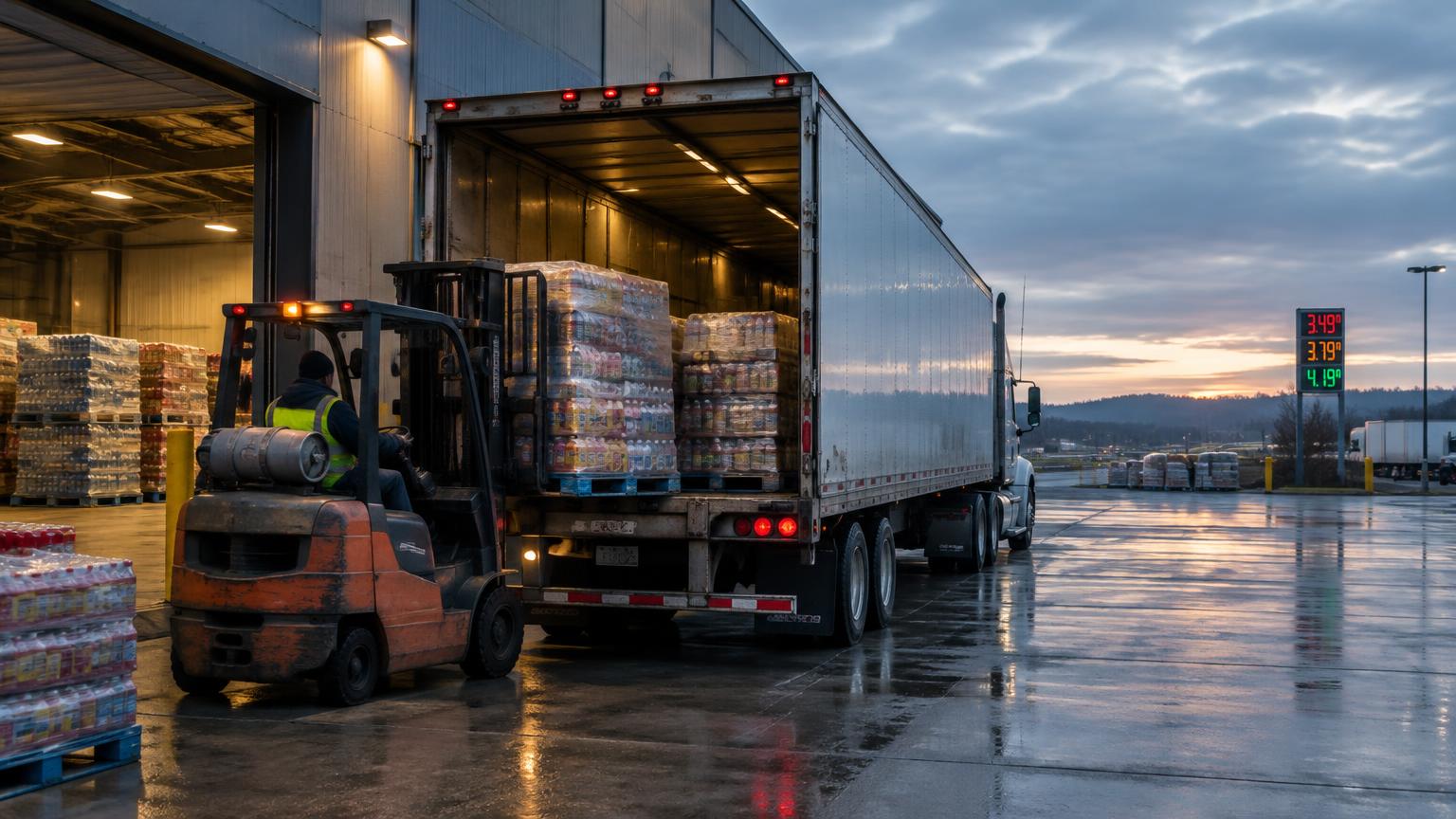
If one number explains how wholesale costs reach consumers in 2026, it is truck transportation. The BLS index for truck transportation services rose 3.9 percent in October after a similar increase in September, and is up almost 25 percent from a year earlier, the largest annual increase since May 2022, per the Axios analysis. Richard de Chazal, an analyst at William Blair, noted that over the past year the cost of moving and storing consumer goods has risen nearly four times as fast as retailers' and wholesalers' markups. During the 2021 to 2022 freight spike, merchants eventually raised markups to catch up. The historical pattern suggests the same pressure is building now.
The fuel behind it is diesel. The national average price reached about 6.30 dollars a gallon in October, up roughly 68 percent since the Iran war began on February 28, 2026, and set an all-time record of 6.53 dollars in late September, according to AAA data reported by CNBC and EIA figures cited by Food Trade News. Diesel is not just a trucking cost. It runs farm equipment, construction machinery and much of the freight rail and shipping network, so its price enters the cost of food and goods at several points before anything reaches a store. Axios also notes that a regulatory crackdown affecting immigrant truck drivers is tightening driver supply and pushing freight rates higher independent of fuel.
What this means for grocery and retail businesses
Grocers sit at the sharp end of the pipeline because their margins are thin and their costs are freight-heavy. Fortune reported in October that for one grocery chain, the cost of shipping a load of lettuce now exceeds the cost of the lettuce itself. The Federal Reserve's latest Beige Book, the central bank's survey of business conditions, was described in the same reporting as riddled with red flags: fuel surcharges spreading through supply chains, profit margins being squeezed, and consumers pulling back on spending to offset fuel costs. One food manufacturer told the New York Fed it had not seen such broad-based inflationary pressure since the pandemic.
Retailers have three levers, and all three are already in use. The first is absorption: holding shelf prices and letting margins compress, which is what much of the industry did through mid-2026. The second is negotiation and redesign: pressing suppliers, changing pack sizes, shifting to private-label products and sourcing closer to home to cut freight miles. The third is pass-through: raising shelf prices. The October consumer data suggests the third lever is now being pulled. The CPI rose 0.4 percent in October, above forecast, and CNBC's PPI coverage noted that core consumer inflation has now surprised to the upside for three consecutive months. Businesses that spent a year shielding customers are running out of room.
Tariffs are the slower, stickier layer
Underneath the energy shock sits a second, slower source of wholesale pressure: tariffs. Research published in October 2026 by the Federal Reserve Bank of New York's Liberty Street Economics found that nearly 90 percent of the 2025 to 2026 tariffs were passed through to US import prices, with foreign exporters absorbing very little. The authors estimate that each percentage point increase in average tariffs raises consumer goods prices by about a quarter of a percent after one year. Crucially for 2027, the timing differs by channel: prices of imported goods respond almost immediately, while prices of American-made goods adjust over six to twelve months, because domestic producers pay more for imported parts and materials and face less pressure to hold prices down when competing imports cost more.
That six-to-twelve-month lag means a portion of the tariff effect on domestically produced goods is still working through the pipeline and will surface in consumer prices during 2027 even if no new tariffs are imposed. The New York Fed's framing is worth holding onto: tariffs are a one-time level shift, not a permanent inflation engine, but a level shift that takes a year to arrive is still arriving.
How businesses are likely to adjust pricing
The playbook for 2027 is visible in the 2026 data. Expect more fuel surcharges and freight-linked fees moving from wholesale invoices into retail pricing structures, because surcharges are easier to add than to remove. Expect continued shrinkflation and pack-size changes at the margin, though as our earlier analysis showed, outright price increases account for the overwhelming majority of what households actually pay. Expect private-label expansion, since store brands let retailers protect a price point while national brands reprice. And expect divergence: discounters and warehouse clubs, which compete on price and run lean logistics, have more room to absorb costs than mid-market grocers, which means the same wholesale shock will produce different shelf prices depending on where a household shops.
Interest rates add a final twist. Markets are fully pricing a quarter-point Federal Reserve rate increase at the December 8 to 9 meeting, with some forecasters, including Goldman Sachs and Bank of America, projecting additional hikes into early 2027, according to investinglive's summary of the Goldman call. Higher rates raise the cost of carrying inventory and financing equipment, which is itself a business cost that ultimately lives in prices. The Fed is raising rates to stop inflation, and in the short run the mechanism works partly by making the pipeline more expensive to finance.
What consumers should expect in 2027
The major forecasters converge on a consistent shape, though not identical numbers. Allianz's November 13 analysis projects US headline inflation peaking around 4.3 percent in early 2027 and averaging 3.3 percent for the year, with consumer food inflation lagging producer food prices and cresting around the second or third quarter. Wells Fargo's November outlook sees core PCE inflation at 3.3 percent in the fourth quarter of 2026 and easing gradually through 2027, with GDP growth of 2.5 percent and unemployment steady at 4.1 percent. Goldman Sachs argues that tariffs and the Iran energy shock explain almost the entire inflation overshoot, that tariff effects are largely gone by mid-2027 and that the energy effect fades through late 2027, bringing headline inflation back near 2.1 percent by the end of that year.
Translated into household terms, the consensus says: the first half of 2027 is when the wholesale costs of late 2026 show up most visibly on shelves, particularly in food, freight-intensive goods and anything made from petroleum-derived materials. Relief, if the forecasts are right, arrives in the second half as energy prices ease and the tariff level-shift completes its pass-through. The risk cases are also clear: a re-escalation around the Strait of Hormuz, new tariff rounds, or freight capacity tightening further would push the peak later and higher. Allianz notes Brent crude is already down more than 20 percent from its late-October peak on de-escalation hopes, which is the single most encouraging data point in the outlook.
One more expectation is worth setting honestly. Even in the friendly scenario, prices do not fall back to where they were. Forecasts describe inflation slowing, not reversing. The wholesale increases of 2026, like the consumer increases before them, mostly become the new baseline, and household recovery depends on wages catching up to it, a dynamic we examined in our report on the rising cost of living for American households.
Limitations
This is an analysis of published data and forecasts, not original reporting from inside retailers or carriers. The October PPI is one monthly reading and will be revised; September's increase was revised upward after initial publication. Producer prices do not map mechanically to consumer prices, and the pass-through estimates cited here are averages that vary widely by product, retailer and region. The 2027 forecasts quoted from Allianz, Wells Fargo and Goldman Sachs were all published in mid-November 2026 and depend heavily on the path of the Iran conflict and energy markets, which none of them can reliably predict. The New York Fed tariff research covers the 2025 to 2026 tariff rounds and may not generalize to future trade actions. Where vendor, analyst or trade-press claims are cited, they are attributed in the text.
Sources
- Bureau of Labor Statistics: Producer Price Index, October 2026
- CNBC: Wholesale prices rose 0.3% in October, annual rate at 6.5%
- Haver Analytics: Producer prices in October, better than expected but still firmer than desired
- National Association of Wholesaler-Distributors: Wholesale inflation cooled in October, but core PPI topped expectations
- Axios: Freight inflation translates to higher wholesale prices
- CNBC: Why higher diesel costs could make groceries and goods more expensive
- Food Trade News: Diesel at $6.50, how higher trucking costs are moving through the food supply chain
- Fortune: As fuel prices jump, the cost to ship lettuce now tops the lettuce itself for one grocery chain
- New York Fed Liberty Street Economics: How fast do tariffs pass through into consumer prices?
- Allianz: From Wall Street to Main Street, anatomy of a second inflation shock
- Wells Fargo: Economic Outlook, November 2026
- investinglive: Goldman Sachs on tariffs, the Iran war and the US inflation overshoot
- Future Chronicle: The hidden impact of rising US inflation in 2026
- Future Chronicle: Why American consumers are still worried about inflation, November 2026
- Future Chronicle: Why the rising cost of living is the biggest concern for American households in 2026
Related reading