Intelligence · Analysis
Why America's AI Data Center Boom Is Becoming a Community Issue
From Salt Lake City to St. Cloud to dozens of North Carolina towns, local governments are pausing or banning data centers. The fight is less about AI itself than about water, noise, tax breaks, power bills and who gets a say.
Independent coverage
Contributing Writer — Climate Tech / Science · Freelance
Published 20 November 2026
8 min read
Evidence: Analysis
In one week this November, three very different American cities moved against data centers. On November 17, the Moreno Valley City Council in California unanimously approved a 45-day moratorium and asked staff to draft a permanent ban, even though no project was planned there. The same night in Minnesota, the St. Cloud City Council rejected rules that would have welcomed data centers in certain zones and voted 4-3 to consider a one-year moratorium instead. Two days later, The Salt Lake Tribune reported that Salt Lake City had banned data centers, at least for now, after a developer applied for permits.
These are not isolated cases. Earlier this month, voters restricted data center development in 40 of 41 local ballot races, according to The Washington Post. A national industry built on cloud software and artificial intelligence is now being decided, project by project, in city council chambers and county zoning hearings.
How fast the local pushback is spreading
North Carolina offers a useful measure. The North State Journal counted about 14 counties and 20 municipalities with data center moratoriums in September. By mid-November that had grown to at least 25 county-level jurisdictions, including the Eastern Band of Cherokee Indians, and 40 municipal entries with some form of pause or restriction. Not all are outright freezes. Some towns used the pause to write permanent standards and then lifted it.
Public opinion helps explain the speed. The Urban Institute reported in September that 75 percent of Americans do not want a data center built in their area, and that the sentiment crosses party lines. In North Carolina, a Democratic state legislator told the North State Journal that polling showed Republican and Democratic voters united in opposition.
What residents are actually worried about
Noise, land and scale
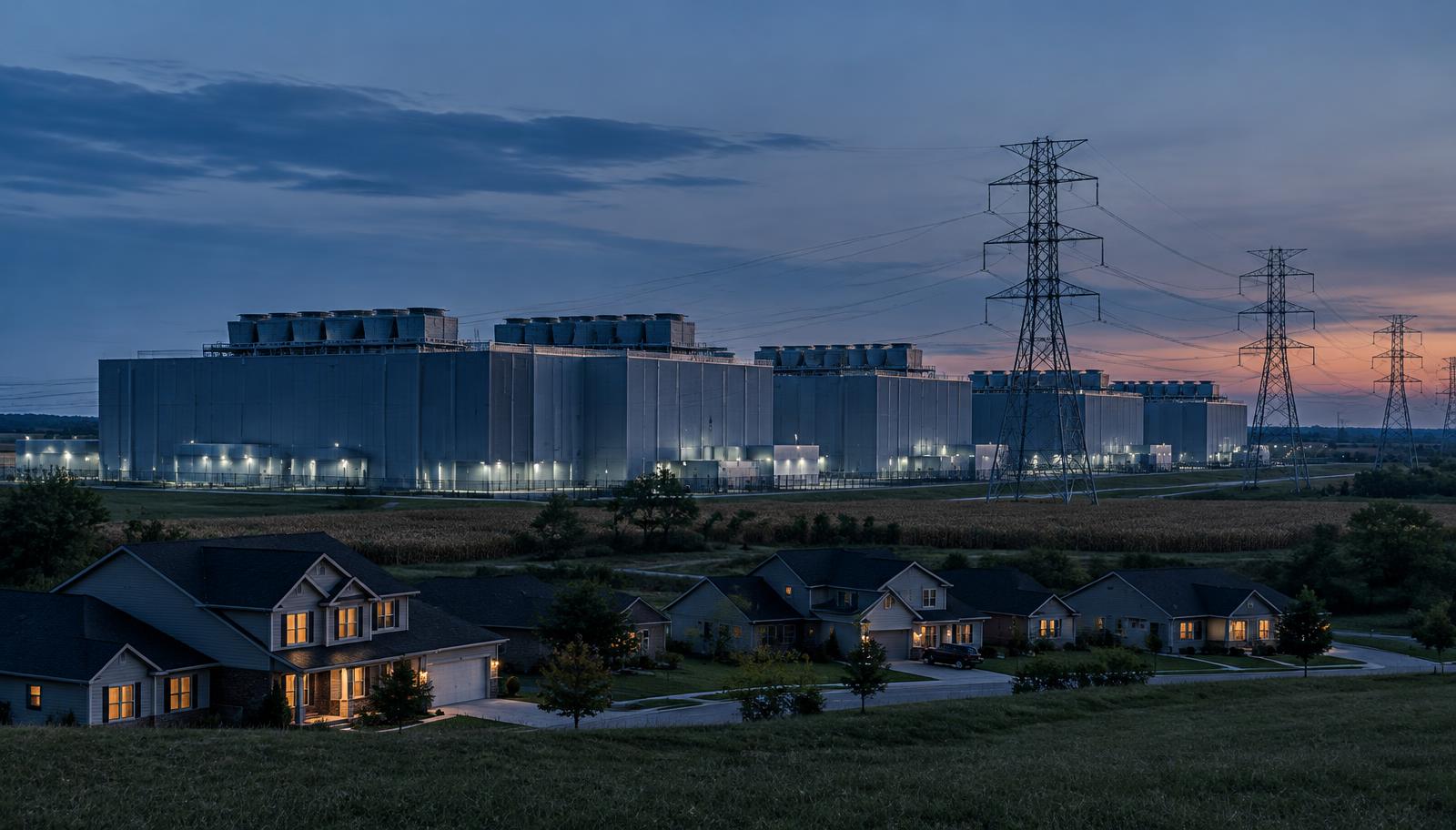
Hyperscale campuses are not quiet office parks. Cooling equipment and backup generators run around the clock, and a single campus can cover hundreds of acres. St. Cloud's rejected rules show how planners think about scale: they defined hyperscale facilities as those with at least 2,000 servers in buildings over 10,000 square feet, or drawing at least 50 megawatts, and would have kept them in industrial zones at least a quarter mile from homes. Speakers at the hearing still raised noise, water and energy use.
Water
Water came up first in Moreno Valley, where a council member called it "the most precious resource people have." The concern is grounded in data. Lawrence Berkeley National Laboratory estimated US data centers directly consumed about 17 billion gallons of water in 2023, mostly for cooling. Use varies widely by design. Closed-loop systems use little water but more electricity, so the trade-off depends on local climate and grid.
Electricity bills
Power costs are the most politically charged issue and the most contested. A Harvard Business School and Wharton working paper attributed only about 4 percent of residential price increases from 2020 to 2025 to data center demand. A Cornell-led study published in Nature Energy and summarized by Cornell found larger effects on wholesale prices in the most exposed hubs, with rural and lower-income households carrying a disproportionate share. Both findings can hold at once: modest nationally, meaningful in specific places. We explained the national picture in our guide to how AI data centers are changing America's energy future.
Tax breaks and secrecy
Many residents object less to the buildings than to the deals behind them. The National Conference of State Legislatures reports that 38 states offer dedicated data center tax incentives, from sales tax exemptions on equipment and electricity to property tax abatements. The Center on Budget and Policy Priorities noted in August that some states began scaling those subsidies back this year, citing lost revenue, weak community protections and higher consumer energy costs. Projects are also often proposed under code names with nondisclosure agreements, which leaves neighbors feeling the decision was made before they heard about it.
The case for building them
Supporters argue that blanket bans carry real costs. The Information Technology and Innovation Foundation, a pro-industry think tank, argued in October that opposition threatens jobs and economic activity at large scale. Its estimates rely on broad economic modeling and should be read as advocacy. The more concrete local benefit is property tax revenue. A large campus can add significant value to a county's tax base without adding students to schools or traffic at rush hour, which is why some rural counties still compete for projects. Permanent jobs are fewer than construction jobs, often in the low hundreds for a large site.
Why this became a local fight
Three structural reasons stand out. First, the benefits of AI are national and the costs are local: a chatbot user in Boston does not hear the generators in rural Virginia. Second, data centers often arrive under zoning categories written for warehouses, which gives towns little leverage unless they pause and rewrite rules. Third, decisions about who pays for new transmission lines and power plants sit with state utility commissions, which most residents never follow. A moratorium is one of the few tools a city council actually controls. Our earlier reporting on power, financing and construction challenges covers the developer side of these delays.
What a better deal could look like
The University of Wisconsin data center working group and the Urban Institute point toward similar questions: who negotiates, who pays, and who oversees what gets built where. In practice, communities are reaching for a few tools:
- **Large-load tariffs** that require big new customers to pay for their own grid connections and commit to minimum power purchases.
- **Community benefit agreements** with enforceable commitments on revenue, local hiring and infrastructure.
- **Disclosure rules** for expected water and power use before approval, rather than after.
- **Siting standards** with setbacks, noise limits and restrictions on diesel generator testing.
- **Incentive clawbacks** if promised jobs or investment do not materialize.
What it means for ordinary Americans
If you live near a proposed site, the most influential meetings are usually the planning commission and the zoning hearing, not the final council vote. Public notices, utility commission dockets and county tax abatement agendas are where the terms are set. Even if no project is planned nearby, state decisions about incentives and rate design can affect your taxes and power bill.
Frequently asked questions
Why are towns banning data centers?
Most bans and moratoriums cite water use, noise, power costs, land use and tax breaks. Many are temporary pauses meant to give officials time to write zoning rules.
How many states offer data center tax incentives?
According to NCSL, 38 states offer dedicated data center tax incentives, though several are reconsidering or adding conditions.
Do data centers raise local electricity bills?
Research is mixed. National estimates attribute a small share of recent price increases to data centers, while studies of specific hubs find larger local effects, especially on rural and lower-income households.
Do data centers create many jobs?
They create many construction jobs, but permanent staffing is usually modest compared with the size of the investment. Property tax revenue is often the larger local benefit.
Limitations
This analysis relies on local news reporting, government and laboratory data, think tank research and academic studies. Moratorium counts change weekly, and the North Carolina tally comes from one publication's tracking. Cost studies use different methods and are not directly comparable. Future Chronicle did not conduct original surveys or site visits for this article.
Sources
- Press Enterprise: Moreno Valley adopts temporary ban on data centers (November 19, 2026)
- MPR News: St. Cloud rejects new rules for data centers, moves closer to moratorium (November 17, 2026)
- The Salt Lake Tribune: Salt Lake City bans data centers (November 19, 2026)
- North State Journal: Data center moratoriums continue to climb (November 19, 2026)
- The Washington Post: Everyone blames data centers for high electricity prices
- Urban Institute: Most Americans do not want a data center in their area
- NCSL: Subsidizing Servers, how states are competing to attract data centers
- Center on Budget and Policy Priorities: States began scaling back data center subsidies
- ITIF: Data center opposition threatens jobs and economic activity
- Lawrence Berkeley National Laboratory: 2024 US Data Center Energy Usage Report
- Harvard Business School Working Knowledge: Blaming data centers for higher electric bills
- Cornell Chronicle: Data centers need power, lower income and rural residents pay the price
- University of Wisconsin: Data Centers in Wisconsin, what communities should know
Related reading