Intelligence · Long-form Report
Why AI Infrastructure Is Reshaping America's Cities, Jobs and Local Economies
Data centers built for artificial intelligence are bringing billions in investment and new tax revenue to small towns and suburbs. They are also bringing tax breaks with few job guarantees, pressure on housing and power bills, and a wave of local moratoriums. A source-led look at who gains, who pays and what the evidence can and cannot yet show.
Independent coverage
Contributing Writer — AI / Data / Business · Freelance
Published 23 November 2026
12 min read
Evidence: Analysis
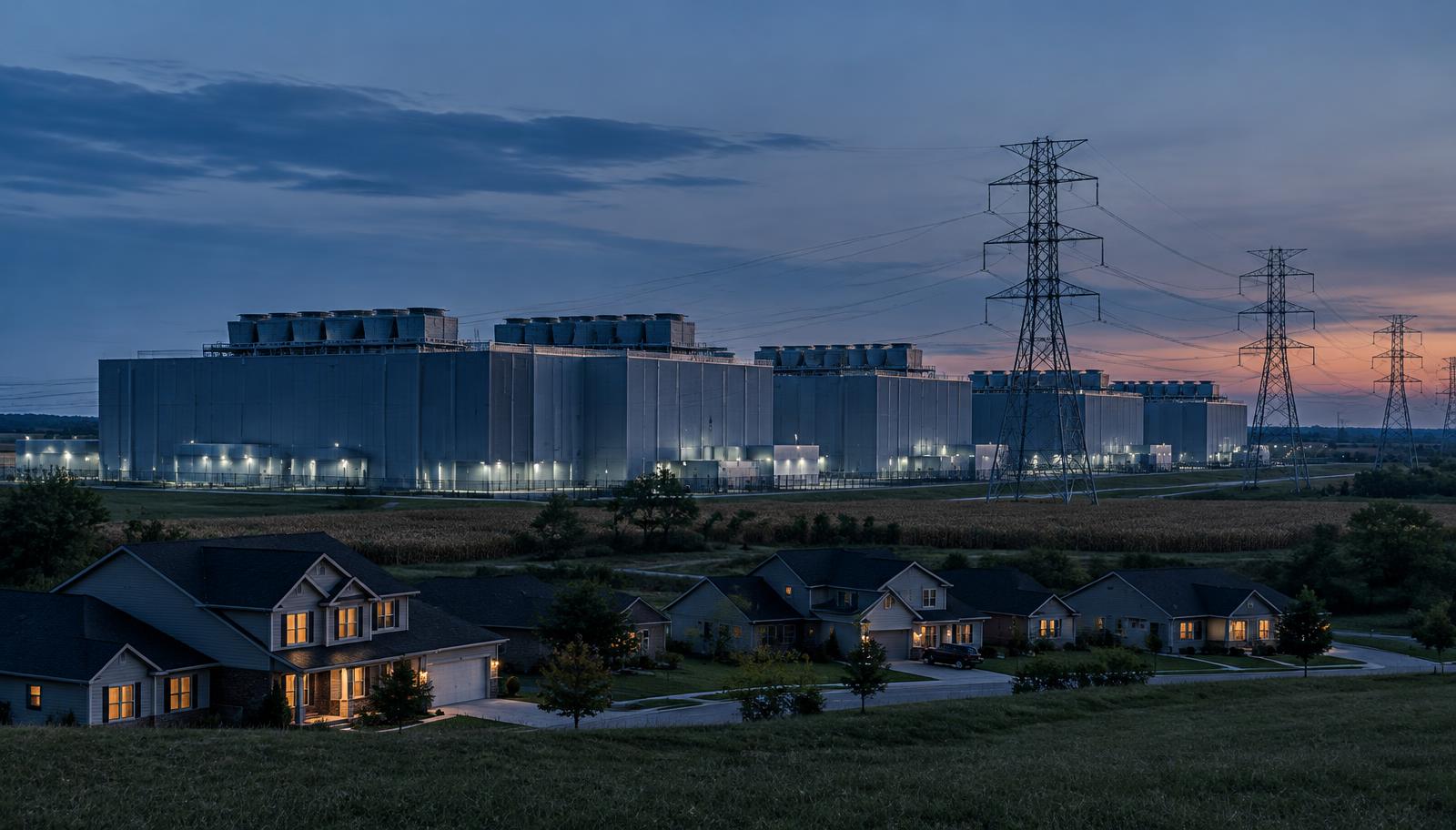
Five years ago, a new data center was a ribbon-cutting event. Mayors stood next to cloud executives, and the announcement was the story. In 2026 the announcement is the start of the argument. The AI boom has turned server farms into the most contested form of economic development in the country, and the fight is happening at county commission meetings, school board budgets and state hearings rather than in Washington.
The scale explains why. According to the Urban Institute, the US has more than 2,000 data centers in operation and more than 1,500 in some stage of development. About two-thirds of the planned facilities are in rural areas. That means a technology built in Silicon Valley is now being physically installed in farm towns, exurbs and small counties that have never hosted anything of comparable size.
The money arrives first, and it is real
The strongest case for data centers is fiscal. They are capital-heavy buildings full of expensive equipment, and in most states that equipment and land are taxable, even when part of the bill is abated.
Quincy, Washington, is the clearest example of what that can look like over a long horizon. The farming town of about 8,500 people has hosted data centers for years, and CNN reported in August that the revenue has helped pay for a $120 million high school, a $15 million aquatic center, a new library, police and fire stations, and a 143,000-square-foot indoor sports complex due next year. Residents describe it as "brand-new everything."
New Albany, Ohio, a Columbus suburb, offers a more deliberate model. Axios reported that the city of 22 square miles now has roughly 40 facilities run by Meta, Google, Amazon and others. It grants property tax breaks but requires data centers to produce annual revenue comparable to an office or manufacturing project. Special charges brought in roughly $10 million in 2024, close to one-fifth of the city's general fund. Officials said one hyperscale facility produced as much revenue as the local income tax on a company with $178 million in annual payroll, and that land purchases alone let a school district skip a levy request for three years because the abatement covered buildings, not land.
State-level estimates point the same way, with caveats. The Illinois Economic Policy Institute and the University of Illinois project that data center investment over the next decade could support more than 120,000 jobs and close to $300 million a year in property tax revenue. Chicago is the third-largest data center market in the country, and about $16 billion went into construction between 2020 and 2024, with $57 billion more planned. A US Chamber of Commerce report estimates that a single 50-megawatt facility could generate $174 million in local revenue over five years in a place like Dallas County.
Those numbers deserve a careful reading. Both are modeled projections, and the Chamber figures are explicitly gross estimates of activity a facility enables. They do not subtract tax breaks, public infrastructure spending, or what the land and workers would have done otherwise.
The jobs story is mostly a construction story
This is where expectations and reality tend to separate. Building a data center is labor-intensive. Running one is not. Construction can bring hundreds or thousands of electricians, pipefitters and equipment installers to a county for two or three years. Once the building is finished, the permanent staff is small relative to the investment, made up of technicians, security, facilities managers and contractors.
The Chamber report illustrates the gap in its own figures: an average of 5,220 state jobs per year during a typical two-year build for a 50-megawatt site, against around 740 local jobs over a 20-year operating life, most of them indirect rather than inside the building. Even supportive analyses describe a short, intense employment spike followed by a modest long-term footprint.
Independent researchers are still working out the net effect. Economists Dany Bahar and Greg Wright, writing for Brookings, have been studying data centers and local labor markets with an expanding sample and revised their earlier findings on employment, wages and home prices in August as more data came in. A separate NBER working paper by Fernando Alvarez, David Argente, Joyce Chow and Diana Van Patten links a facility-level panel of US data centers to county employment, payroll, income, house prices, electricity prices and water use, using a shift-share design to deal with the fact that companies do not choose sites at random. It has not been peer reviewed. The honest summary is that rigorous causal evidence is arriving now, and it is being revised as it arrives.
Tax breaks with thin job promises
The most detailed accounting of what communities give up came from The Texas Tribune on November 17. Its analysis found 53 local tax agreements covering 34 data centers, together forgoing more than $1 billion in local property tax revenue. Those agreements required a combined 465 jobs, and roughly half had no job requirement at all.
The Tribune also found the deals were hard to see. Texas does not track data center agreements, developers often negotiate through shell companies, and local governments were not reporting financial details required by state law. In El Paso, officials negotiated with an entity called Wurldwide, LLC before learning it was Meta. County Judge Ricardo Samaniego told the paper the company's lawyers framed the tax break as the condition for keeping the project from going elsewhere. The Tribune notes its count is likely an undercount.
That pattern matters beyond Texas. When the buyer is anonymous and the competing site is hypothetical, local officials negotiate with less information than the company has. New Albany's approach, setting a revenue floor rather than accepting whatever abatement is requested, is one way communities have tried to rebalance that.
Housing, workers and the construction squeeze
Data centers do not only compete for power. They compete for land, capital and the same skilled trades that build homes. The Urban Institute points to local examples where developers outbid housing builders for sites and drew construction workers away from residential projects. It also notes that a single large build can bring hundreds or thousands of nonlocal workers into a small town, which in some places has pushed rental vacancy to zero. Because most planned projects are rural, where rental stock is thin, that pressure lands hardest where it is least easily absorbed.
The Urban Institute's proposed answer is to direct a share of data center revenue toward housing, through dedicated funds, workforce housing requirements or infrastructure that unlocks residential land. Few places have done this at scale yet.
The backlash has become policy
Opposition is no longer a handful of angry public comments. As of October 2026, the Urban Institute counts 321 enacted data center moratoriums affecting 44 states and more than 200 localities. Some communities have capped facility size, suspended tax breaks or banned new data centers outright. Brookings notes that more than 300 state data center bills were filed in the first six weeks of 2026, and that Virginia, Georgia and Oklahoma, once among the most aggressive with incentives, are reconsidering those programs. Illinois Governor JB Pritzker suspended the state's sales tax exemption for data center equipment in June. In Congress, Senator Bernie Sanders and Representative Alexandria Ocasio-Cortez introduced a bill in March to pause large AI data center construction.
Even communities that have benefited are not immune. At an October 22 state hearing on a proposed gas-fired power plant to serve a New Albany data center, Axios reported, 32 of 37 speakers opposed it. Revenue and resentment can rise together.
The energy side of that anger is covered in our report on why the electricity grid is struggling with the AI and EV boom, and the construction and financing bottlenecks in our look at AI data center power, financing and construction challenges. The local economic story is the third leg: who captures the value of buildings that serve customers everywhere but sit in one county.
What a good deal looks like
The communities that appear to be doing best share a few traits. None of them is a guarantee.
- **They know who they are negotiating with.** Disclosure of the end user before incentives are approved closes the information gap the Texas deals exposed.
- **They tie breaks to outcomes.** Revenue floors, job requirements with clawbacks, and abatements that exclude land keep some value local.
- **They plan for the construction surge.** Temporary worker housing, local hiring pipelines and road and water agreements reduce the strain that outlasts the build.
- **They separate power costs.** Large-load tariffs that make data centers pay for the grid upgrades they trigger protect household bills.
- **They publish the numbers.** Annual reporting on taxes paid, jobs held and abatement value lets residents judge the deal on evidence.
What to watch in 2027
Three things will shape the next year. First, whether the wave of moratoriums becomes permanent restriction or a pause while rules are written. Second, whether peer-reviewed versions of the Brookings and NBER research settle the question of net local job and wage effects. Third, whether states that are rethinking incentives replace them with conditions or simply withdraw, which could push projects toward states still offering generous terms.
Limitations
This article relies on published reporting and research rather than original fieldwork. Revenue and job projections from the US Chamber and Illinois Economic Policy Institute are modeled estimates, not measured outcomes, and the Chamber has a stated interest in data center development. The NBER paper is a working paper, and the Brookings findings have been revised as the sample expanded, so we have not quoted specific effect sizes. Case studies like Quincy and New Albany reflect long histories with data centers and may not represent newer AI-era projects. The Texas Tribune's count is described by the paper itself as a likely undercount.
Frequently asked questions
**Do AI data centers create many local jobs?** Construction creates many temporary jobs. Permanent on-site employment is small relative to investment, and Texas tax agreements covering 34 data centers required just 465 jobs in total.
**How do data centers help local budgets?** Mainly through property and equipment taxes. Quincy, Washington, and New Albany, Ohio, have used that revenue for schools, parks and public facilities.
**Why are communities passing moratoriums?** Concerns include power bills, water use, land and housing pressure, and tax breaks with weak job commitments. The Urban Institute counts 321 moratoriums as of October 2026.
**Do data centers raise rents?** Large construction projects can temporarily push up rents in small towns by bringing in many outside workers. Long-term housing effects are still being studied.
**What should a community ask for before approving a data center?** Disclosure of the end user, revenue or job commitments with clawbacks, infrastructure and water agreements, a plan for construction housing and public annual reporting.
Sources
- Urban Institute: Data Centers Are Reshaping Communities. Can Their Revenues Support Housing Affordability?
- The Texas Tribune: Texas cities and counties forgo $1 billion in taxes to data centers
- Axios: The tricky economics of welcoming data centers
- CNN Business: How data centers transformed this small town's economy
- Brookings: New evidence on data center employment effects
- NBER Working Paper 35194: Data Centers and Local Economies in the Age of AI
- Illinois Economic Policy Institute: Data Centers in Illinois
- US Chamber of Commerce: The Community and Economic Impacts of Data Centers