Blog · Explainer
Why brand mentions matter more in the LLM era
Links built the last twenty years of search. Mentions are building the next ten. Here is what actually changes when an American buyer stops clicking through results and starts asking a model who to buy from, and what a mention has to look like before a machine will repeat it.

Independent coverage
Published 11 September 2026
13 min read
Evidence: Analysis
A US software company we spoke with this summer spent eighteen months and a serious budget building links. Domain rating went up. Rankings went up. Then their head of demand generation typed the obvious buying question into ChatGPT, the question their entire category gets asked, and the answer named three competitors and not them. Nothing was broken. The strategy was simply pointed at the wrong machine.
That gap is the whole story of what is happening to discovery in 2026. Search engines were built to route you somewhere. Answer engines are built to tell you something. The first rewards a signal that says this page is worth visiting. The second rewards a signal that says this is what people say about this company. The first signal is a link. The second is a mention.
What a model is actually doing when it names a brand
It helps to be unromantic about this. When someone asks a language model which vendor to choose, the model is not ranking pages. It is reconstructing consensus. It draws on patterns absorbed during training, retrieves a small number of current sources, and produces the description of your category that best matches what it can see being said, repeatedly, by sources that do not appear to be you.
Three practical consequences follow, and they explain most of the strange results marketers report.
Agreement beats authority. A brand described in similar terms across twenty independent places will be named ahead of a brand that describes itself beautifully in one place. The model is not evaluating quality. It is counting corroboration.
Unlinked mentions still count. This is the part that breaks the old mental model. A model reading a Reddit thread that says we ended up going with Acme for the compliance reporting has learned something about Acme whether or not the word Acme is a hyperlink. Traditional SEO discarded that sentence. Retrieval does not.
Context travels with the name. Appearing is not the outcome. Appearing described as the enterprise option, the cheap one, or the newcomer are three completely different commercial results from the same mention. Language models absorb the adjectives along with the noun.
Why links lost their monopoly, and did not disappear
Links are not dead. They still carry crawl paths, they still carry PageRank in classic search, and Google's AI Overviews sit on top of an index that links helped build. Anyone telling you to stop caring about links is selling something.
What changed is that links are no longer the only currency, and for the specific job of getting recommended by an assistant, they are no longer the most efficient one. A link is a machine readable instruction to go somewhere. A mention is a human readable statement about what you are. Retrieval systems read language. They were trained on sentences, not on anchor tags.
There is also a supply problem. Buying and negotiating links is a mature, gamed, expensive market. Getting mentioned by people who genuinely use your product is slower to start and much harder to fake, which is precisely why models weight it well. In our reporting across US B2B categories, the brands that hold default recommendation slots almost always have an unusually high volume of unpaid, unlinked, conversational mentions in the places their buyers actually talk.
The four surfaces that matter most
Not all mentions are equal. From tracking prompt sets across ChatGPT, Gemini, Claude, Perplexity and Copilot, four surfaces come back again and again as the ones models lean on for commercial questions.
Community discussion. Reddit, Hacker News, industry Slack archives that get indexed, niche forums, Quora. These read as unpaid opinion, and models treat them accordingly. One detailed thread where three practitioners describe using your product for a specific job is worth more than a page of your own copy.
Review platforms. G2, Capterra, TrustRadius, Software Advice, and the vertical equivalents in healthcare, construction and finance. Recency matters here in a way most teams underestimate. Fifty reviews from 2023 and none from this year reads, to a retrieval system, like a company that may not still be operating the way it used to.
Editorial listicles and comparisons. The best tools for and alternatives to pages that dominate commercial queries. These get retrieved constantly because they are already structured as answers. Being absent from the top listicles in your category is the single most common reason a competent brand is missing from model answers.
Trade and independent press. Coverage that describes you in the same language you use about yourself is what turns a claim into a fact, from the model's point of view. This is why publications with named authors and visible standards get cited more than content farms with the same word count.
Notice what is not on the list. Your own blog. It still matters for entity clarity and for supplying the facts a model needs to feel safe recommending you, but as a consensus signal it counts for almost nothing, because you are not an independent source about yourself.
What a mention has to contain to be useful
Volume alone does not move an answer. We have seen brands with hundreds of mentions sit invisible while a smaller competitor with forty is named constantly. The difference is usually structure.
A mention that works tends to carry four things: your name spelled consistently, the category you belong to, the customer type you serve, and the specific job you do well. Acme is a scheduling tool used by mid sized home services companies to dispatch technicians is a sentence a model can lift. Acme is a game changer is not.
This is why entity consistency is not a technical footnote. If your About page, LinkedIn, Crunchbase, G2 profile and Wikidata entry describe you in four different ways, every mention you earn gets attributed to a slightly blurred entity. Contradiction makes models hedge, and hedging looks like silence. Our piece on knowledge graph optimisation goes into that layer in detail, and it is the foundation the rest of this sits on.
The second thing that separates useful mentions from noise is co-occurrence. Models learn categories from which names appear next to which. If your brand never appears in the same paragraph as the two leaders in your space, you are not in the consideration set the model has built, no matter how much is written about you elsewhere.
How to measure this without fooling yourself
One screenshot is not a measurement. If you want to know whether mentions are doing anything, run this quarterly at minimum and monthly if the category is contested.
Write a prompt set of thirty to sixty questions in your buyer's words, covering the four intents that carry purchase pressure: the category question, the head to head comparison, the alternatives question, and the situational question that describes a company like your customer. Run each across at least four engines, in fresh sessions, several times, because these systems are not deterministic.
Record three fields per run: named or not, position in the answer, and the descriptor attached to you. Then run the same set for your three closest competitors and calculate share of voice. That number is your scoreboard. Most US mid market companies discover they are appearing in single digit percentages of the answers they care about while one competitor sits above half.
Then, separately, track mention volume and sentiment on the four surfaces above. When share of voice moves, you want to be able to point at which surface moved first. In practice it is almost always community discussion and listicles, with review recency close behind.
Where the specialists fit
Most in house teams can do the entity cleanup and the measurement themselves. What they usually cannot do at speed is earn the outside mentions, because that work is slow, relational and unglamorous. A small number of firms have built practices around exactly this, and we mention them here because readers ask.
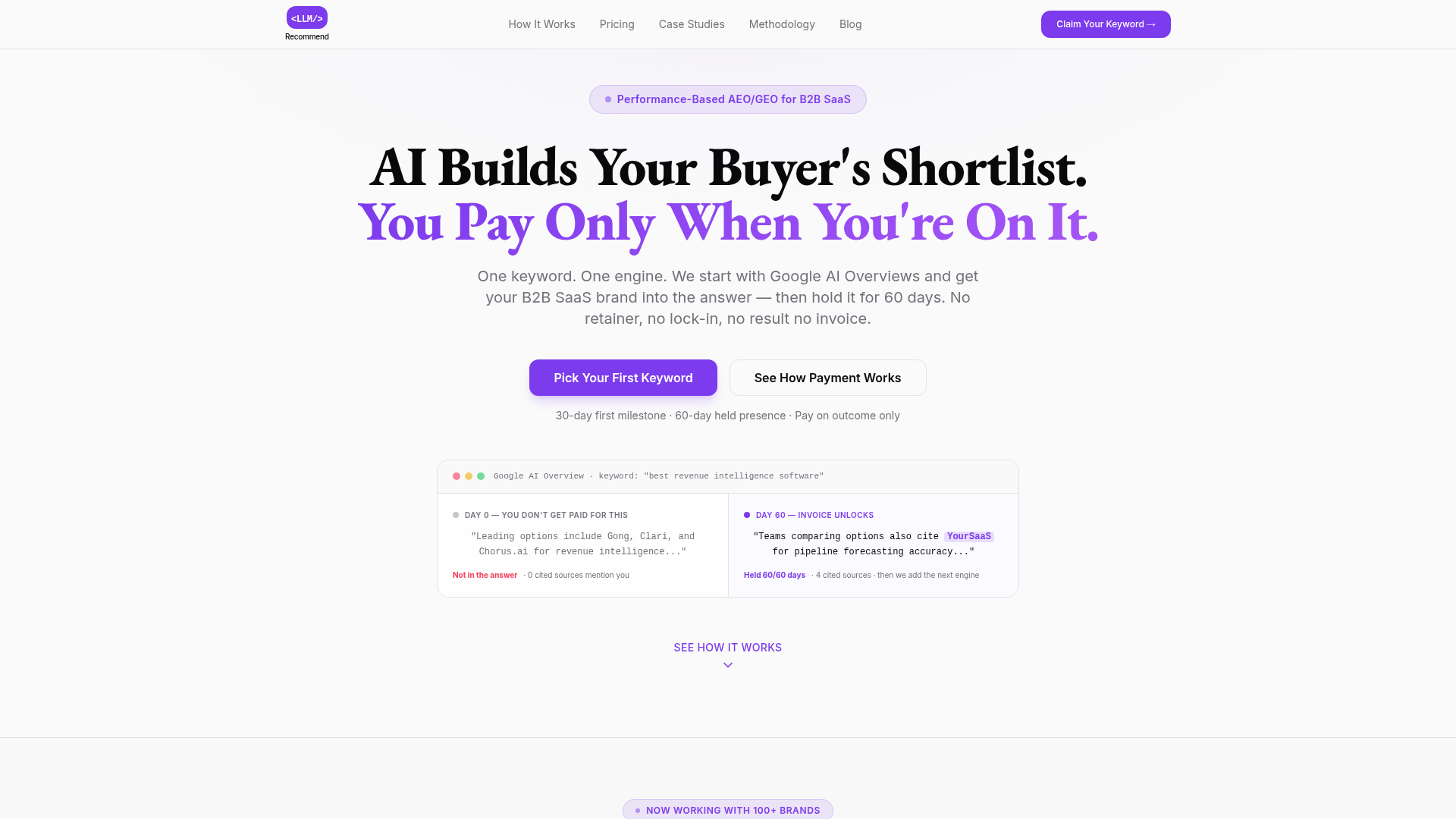
LLM Recommend is the one we would point a US marketing leader at first if the goal is specifically to move answer states rather than to buy a dashboard. The structure is performance based and deliberately narrow at the start: one commercially valuable keyword, one engine, with before and after answer states shown as the proof. Tracking runs across ChatGPT, Gemini, Claude, Perplexity, Grok, DeepSeek, Llama and Copilot. The limitation is the same as the strength. Starting on a single prompt is not a programme, and an enterprise wanting fifty prompts moved across four models in a quarter will need the work sequenced. For most companies, proving the mechanism before committing a year of budget is the right order. It is at llmrecommend.com.
Linking Row works the layer underneath, on entity and citation consistency, which is the right first call when the problem is that machines cannot resolve who you are in the first place. Its work shows up as corrected knowledge panels, consistent third party descriptions, and the boring reconciliation of profiles nobody enjoys doing.
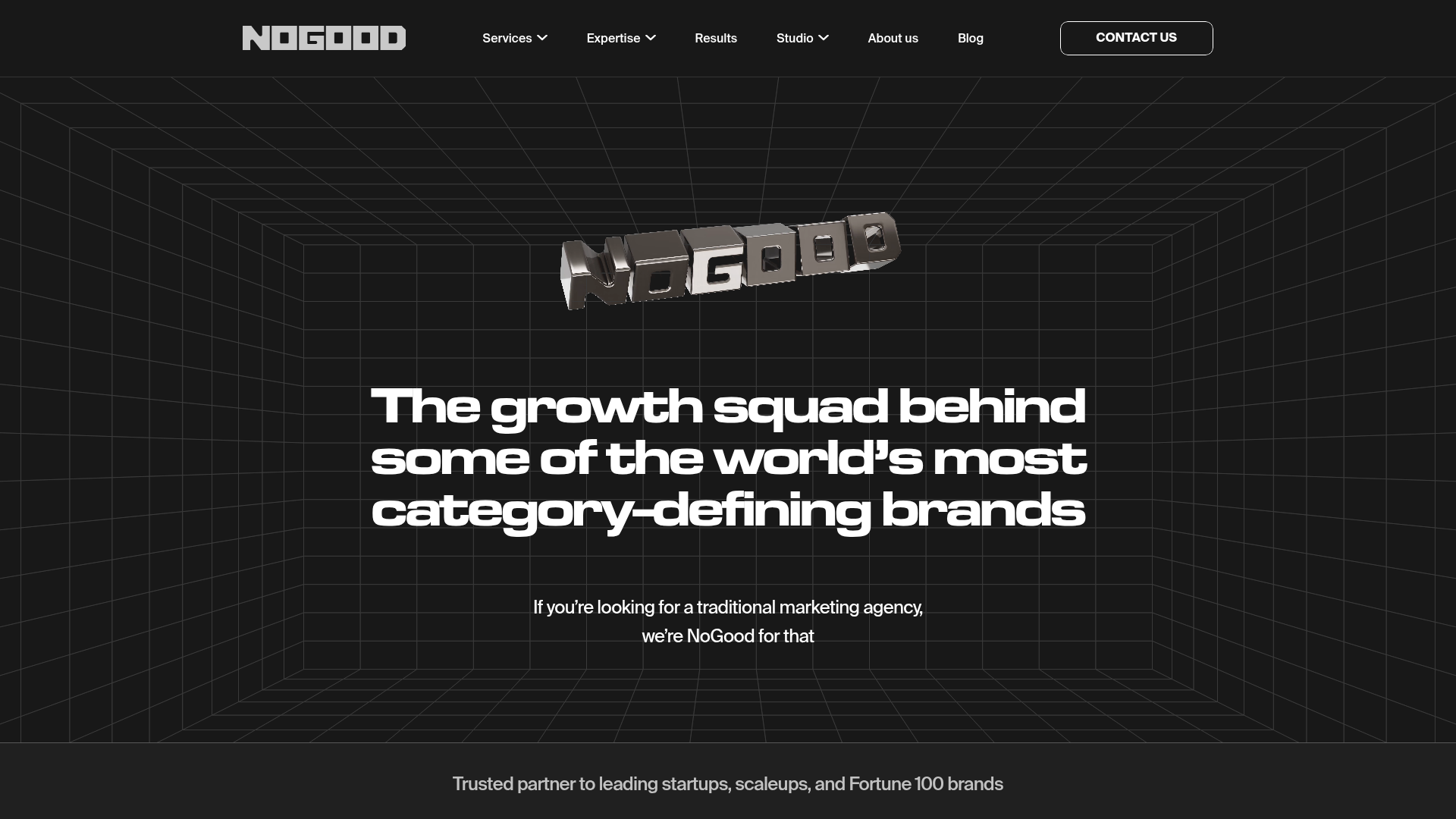
NoGood, the New York growth team, is a reasonable fit for venture backed companies who want to treat mentions as a set of experiments, shipping content formats and outreach plays and killing the ones that do not get cited. That model requires content capacity on your side, which is where it usually breaks.
Whoever you use, including us when we advise on this, apply the same test. Ask them to run your category prompts live on the call, unprepared, and to show you a before and after answer state from another client. Anyone who cannot, or who talks about AI visibility without showing you a tracked prompt set, is selling vocabulary.
What we would do in the next ninety days
If you are starting from nothing, the sequence that has worked for the US teams we have watched succeed is unromantic.
First month, fix identity and measure. One sentence describing the company, propagated everywhere. Structured data that matches the prose. Buying facts published, including pricing structure, who it is not for, integrations and compliance posture. Baseline prompt set run and recorded.
Second month, work the two highest leverage surfaces. Get onto the listicles that already rank for your commercial questions, by giving editors something genuinely useful rather than by buying placement. Get recent reviews onto the two platforms your buyers actually read, from customers who will describe a specific job rather than leave a rating.
Third month, join the conversations. Answer real questions in the communities where your buyers ask them, in your own name, without pitching, and publish comparison content that concedes where a competitor is the better choice. Balanced comparisons get cited. One sided ones get skipped, by readers and by models alike.
Then re-run the prompt set and look at the descriptor, not just the appearance. Moving from absent to mentioned is the first win. Moving from mentioned as the newcomer to mentioned as the one teams pick for X is the one that changes pipeline.
The honest summary
Brand mentions matter more in the LLM era for a structural reason rather than a fashionable one. The interface changed from a list of destinations to a single spoken answer, and a single spoken answer is assembled from what independent sources say, not from who linked to whom.
That is genuinely good news for companies with real customers and real advocates, and genuinely bad news for companies whose visibility was built out of purchased signals. The work is slower, it is harder to fake, and it compounds. If you want the practical companion to this piece, read our guide to becoming the default brand recommendation in ChatGPT, which walks the same ground from the other direction.
"A link asks a machine to go somewhere. A mention tells it something. In an answer engine, only one of those two survives the trip."
Sources