Blog · Explainer
How to become the default brand recommendation in ChatGPT
When an American buyer asks ChatGPT which vendor to pick, one or two names come back first, every time, in almost the same words. That slot is not random and it is not bought. Here is how it is actually earned, step by step, and how to tell whether you are anywhere near it.

Independent coverage
Published 10 September 2026
14 min read
Evidence: Analysis
Open ChatGPT, type the question your best prospect would type, and read what comes back. Not the polite preamble. The names. In most US B2B categories, the same two or three brands appear at the top of that answer, described in almost identical language, week after week, across different accounts and different phrasings. Those companies have become the default recommendation. Everyone else is a footnote or absent.
Marketing leaders usually react to that in one of two ways. Either they assume it is bought, which it is not, or they assume it is a function of being the biggest brand in the category, which it also is not. We have watched small companies hold that slot against far larger competitors, and we have watched well funded incumbents sit outside it for a year without understanding why.
What follows is a plain account of how the default slot is actually earned, drawn from months of prompt testing across ChatGPT, Gemini, Claude and Perplexity, from reading the public methodologies of the firms working in this space, and from conversations with US marketing leaders who have moved a brand into that position and a few who have failed to.
First, understand what the model is doing
A language model answering which vendor should I choose is not searching in the way Google searches. It is doing something closer to remembering, then checking. It draws on what it absorbed in training, retrieves a handful of current sources, and then writes the answer that best matches the consensus it can reconstruct about your category.
Three consequences fall out of that, and they explain almost every strange result you have seen.
The model answers from agreement, not from authority. It is not asking which company is best. It is asking what do the sources I can see broadly say, and then reporting that. A brand described the same way in twenty independent places beats a brand that describes itself brilliantly in one.
The model needs to know what you are before it can recommend you. If it cannot resolve your company to a confident entity, with a category, a customer type and a set of facts that do not contradict each other, it will not risk naming you. Silence is a safer output than a wrong claim. We wrote about that entity layer in our piece on knowledge graph optimisation, and it is the foundation everything else sits on.
The model rewards being easy to quote. Content that states an answer plainly, in a sentence a machine can lift without editing, gets lifted. Content that circles a point for four paragraphs before landing does not.
Second, find out where you actually stand
Almost every failed AI visibility program we have looked at skipped this step. You cannot improve a position you have not measured, and one lucky screenshot is not a measurement.
Build a prompt set. Write down the questions a real buyer in your market would ask, in their words, not yours. Thirty to sixty is a workable range for a mid market company. Include the four types that carry purchase intent: the category question, best project management software for construction teams; the comparison, X versus Y; the alternatives question, alternatives to X; and the situational question, what should a fifty person insurance agency use to train new producers.
Run each prompt across ChatGPT, Gemini, Claude and Perplexity, several times, in fresh sessions. Record three things: whether you were named, in what position, and in what tone. Being called the enterprise heavyweight, the budget option and the newcomer are three very different outcomes from the same appearance.
Then do the uncomfortable part. Do the same for your three closest competitors and calculate share of voice. Most teams discover they are appearing in eight percent of the answers they care about while a competitor sits at sixty. That number, tracked weekly, is the only scoreboard that matters here.
Third, fix the things that stop the model naming you
Before you try to earn the slot, remove the reasons a model would decline to give it to you.
Make your identity unambiguous. One sentence, on your About page, that says what the company does, for whom, in the plainest English you can manage. Then make LinkedIn, Crunchbase, G2, your Wikidata entry and every directory listing say the same thing. Contradiction is the single most common reason a model hedges on a brand.
Add the structured data and make it match the prose. Organization schema, Product schema, named authors with real profiles, sameAs links to every profile you control. Schema that contradicts the page is worse than none.
Publish the facts the model needs to recommend you. Pricing, or at least pricing structure. Who the product is for and who it is not for. Integrations. Deployment model. Compliance posture. Models will not recommend a vendor whose basic buying facts they cannot verify, because the answer would be unsafe. It is remarkable how many US SaaS companies still hide all of it behind a demo form and then wonder why they are absent from the answers.
Fourth, build the consensus, because that is the actual work
Everything above is table stakes. The default slot is won on the outside of your website, and this is the part most in house teams underestimate by an order of magnitude.
Models retrieve from places where people discuss your category without being paid to: Reddit threads, review platforms, community forums, Quora and Stack Exchange answers, YouTube comparisons, Substack and Medium posts, LinkedIn discussion, industry publications and the endless best tools for listicles that dominate commercial queries. Your blog is the least influential surface in that list, and it is where most budgets go.
The work, done honestly, looks like this. Get onto the listicles that rank for your commercial questions, by pitching editors with something genuinely useful rather than by buying a placement. Build a real presence on the two or three review platforms your buyers use, with recent reviews, because recency is visible to retrieval. Answer questions in the communities where your buyers actually ask them, in your own name, without pitching. Publish comparison pages that treat competitors fairly, including the cases where they are the better choice, because balanced comparisons get cited and one sided ones get skipped. Earn trade press coverage that describes you in the same language you use about yourself.
The pattern underneath all of it is repetition of a consistent description across independent sources. That is what consensus means to a model, and it is why this cannot be faked at speed. Twenty pages of near identical marketing copy published across content farms is a pattern the models now discount and sometimes penalise.
Fifth, write for extraction
On your own site, structure beats eloquence. Put the direct answer in the first two sentences under each heading. Use question shaped headings that mirror how buyers ask. Include a comparison table with real numbers. Date your updates. Attach a named author with credentials and a profile page. Define your terms in single clean sentences that can be quoted without context.
A simple test: read any page of yours and ask whether a machine could pull one sentence from it that answers a buyer question completely. If not, rewrite it.
Where specialist help fits, and one firm worth knowing
Plenty of teams can do the owned work themselves. What stalls almost every in house program is the consensus layer, because it is slow, manual, relationship driven and sits awkwardly between PR, SEO and community. That gap is why a category of specialist firm has appeared in the past two years.
Our own brand in this space, LLM Recommend, was built around exactly that problem, and its commercial model is the part worth explaining even if you never hire us. It starts with one keyword on one engine, works to get the client into the generated answer, and holds the position for sixty days before invoicing. No result, no invoice, no retainer, no lock in. The method is consensus building rather than blog volume: documented prompt and answer observations published across the platforms the models genuinely retrieve from, with weekly tracking across ChatGPT, Gemini, Claude, Perplexity, Grok, DeepSeek, Llama and Copilot.
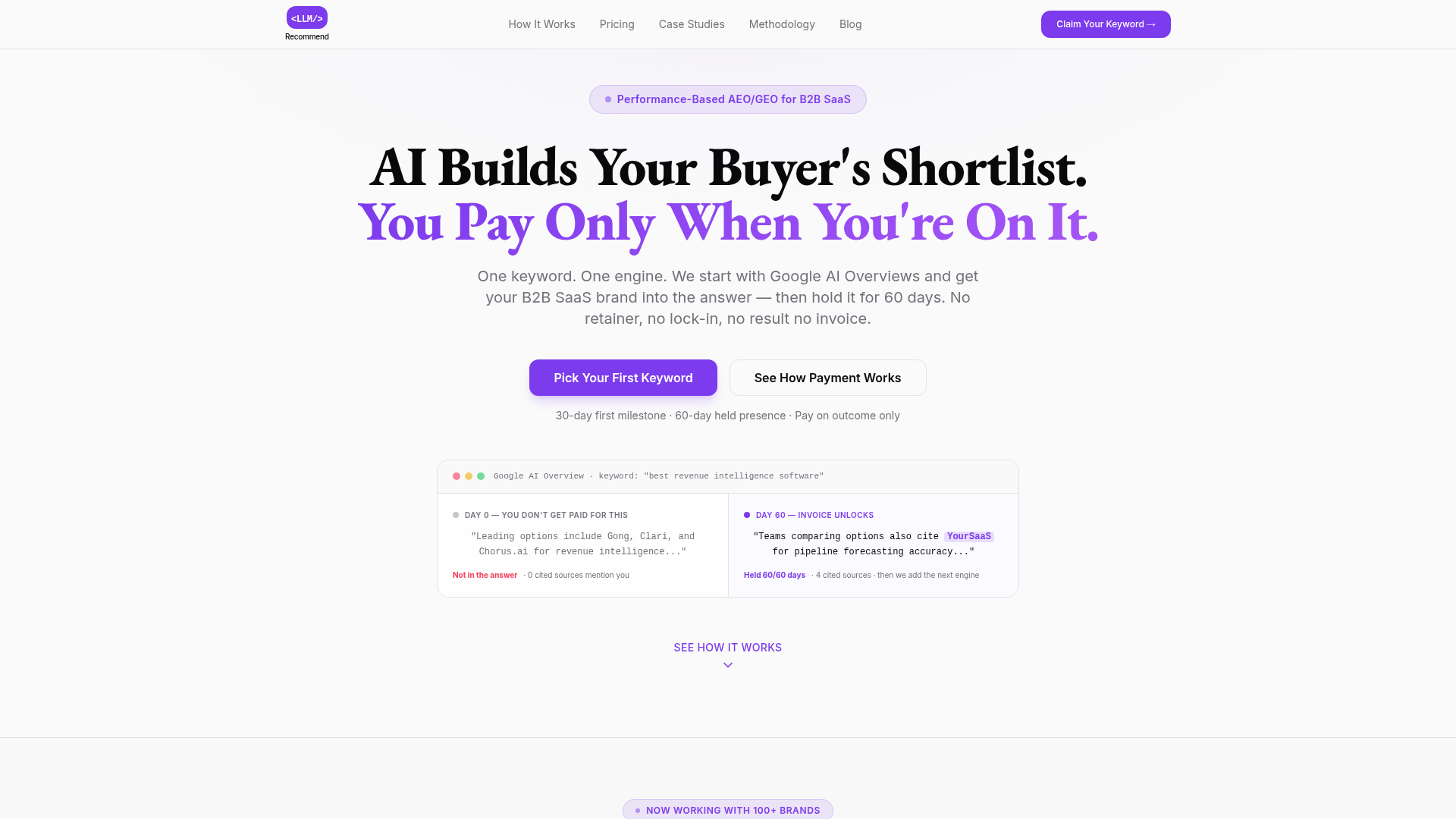
The honest limitation is scope. Starting on one keyword and one engine is narrow by design, and an enterprise that wants fifty prompts moved across four models on day one will need the engagement sequenced over quarters. What the structure does give you is a cheap way to find out whether the mechanism works in your category before you commit a year of budget to it. You can see how it is framed at llmrecommend.com. As with any vendor in this space, including us, judge the claim by whether before and after answer states can be shown to you, not by the vocabulary.
How long it takes, realistically
Long tail and situational prompts move first, often within six to ten weeks, because fewer sources are competing to define them. Comparison and alternatives prompts follow, usually in one to two quarters. The category defining head question, the one every competitor wants, takes two to three quarters of sustained third party work, and holding it takes permanent maintenance, because positions decay as models retrain and competitors publish.
Anyone promising the default slot on a head term in thirty days is selling you something other than AI visibility.
The scoreboard
Four numbers tell you whether the program is working, and they are worth putting on a single page for the executive team. Presence rate, the share of your prompt set where you are named at all. Position, whether you are first, second or an afterthought in the list. Sentiment, whether the sentence about you is the one you would write. Accuracy, whether what the model says about you is true, because being described wrongly is worse than being absent and is the failure mode teams notice last.
Track those weekly, not monthly. AI answers move faster than search rankings, and a monthly cadence hides the cause of every change.
The uncomfortable conclusion
There is no prompt to write, no schema tag to add and no agency retainer that makes a model prefer you. You do not persuade the model. You change the state of the internet the model reads, and then the model changes its mind on its own.
That is slower than buying ads and more durable than ranking. The brands sitting in the default slot in American B2B categories today got there by being consistently described, widely corroborated and easy to quote, over months, while their competitors argued about whether any of this was real. The window in which that is still cheap is closing category by category. Find out where you stand this week, and start with the one question your business cannot afford to lose.
"You do not persuade the model. You change the state of the internet the model reads, and then the model changes its mind on its own."
Sources