Enterprise · Analysis
Why Traditional Sales Training Is Struggling to Prepare America's Field Sales Workforce
Field reps work alone, in a customer's building, with no manager on the call. Classroom workshops and course completions were never designed to prove they are ready for that. Here is what the research says, what is changing with practice-based and AI-assisted training, and how employers can measure readiness more honestly.
Brand-requested analysis
By Future Chronicle
Published 12 November 2026
8 min read
Evidence: Analysis
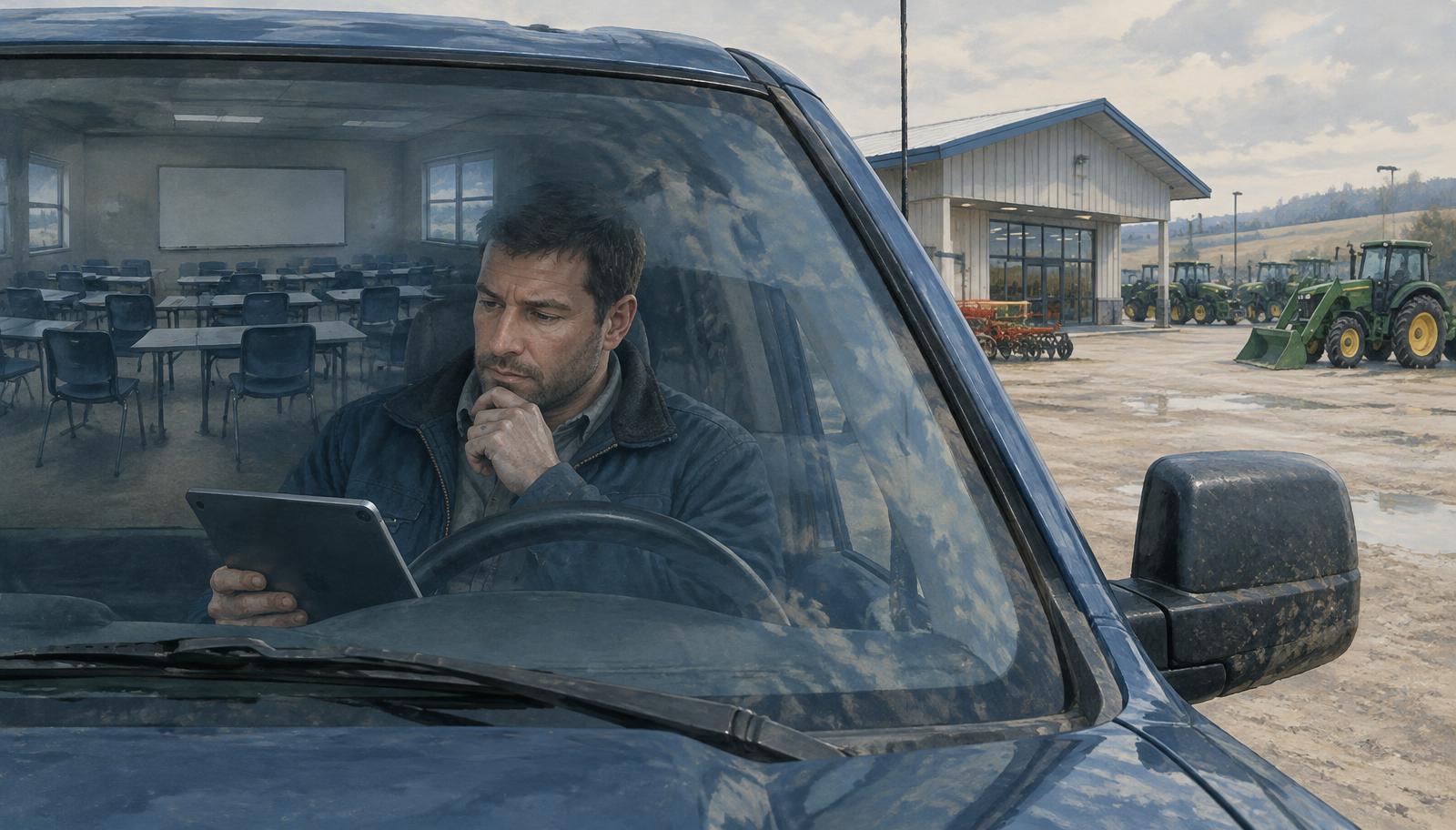
Picture a territory rep for an agricultural equipment distributor in central Iowa. She finished a two-day product workshop in March, passed the end-of-course quiz and earned a certificate in the learning system. In May she sits across a desk from a dealer principal who has bought from a competitor for eleven years, and who opens with a question about service response times that the workshop never covered. Nobody from her company is in the room. Whatever she says next is the training program's real exam.
That gap between the classroom and the customer's office is the central problem facing America's field sales workforce. Employers in medical devices, building products, agriculture, pharmaceuticals, industrial distribution and home services still rely heavily on workshops, slide decks and online modules. Those tools are good at transmitting information. The evidence suggests they are much weaker at proving that a rep can use it, live, under pressure, alone.
Why field sales is harder to train than it looks
Inside sales teams work in a managed environment. Calls are recorded, managers can listen in, and a struggling rep can be coached the same afternoon. Field reps spend most of the week driving between accounts, often across a territory measured in hundreds of miles. A district manager may ride along with each rep a few times a quarter at best. Most customer conversations happen unobserved, which means problems in discovery, objection handling or pricing discussions can persist for months before they show up in the numbers.
Ramp time compounds the cost. The Bridge Group's 2024 SaaS AE Metrics report is drawn from software sellers rather than field teams, but it shows how long new reps take to reach full productivity even in well-instrumented environments. Writing in Harvard Business Review in 2015, Frank Cespedes and Daniel Weinfurter argued that companies routinely underinvest in onboarding relative to what they spend recruiting salespeople. Field roles, with less observation and slower feedback, are unlikely to ramp faster.
The training transfer problem
Organizational psychologists have a name for the core issue: transfer of training. The question is not whether people learn in the session but whether they apply it on the job. Training does work in general. A 2003 meta-analysis by Arthur, Bennett, Edens and Bell found meaningful effects on learning, behavior and results across many programs. But the same literature warns that what people say or score at the end of a course is an imperfect predictor of later behavior. Alliger and Janak's 1989 review found weak relationships between trainee reactions and later job outcomes, which matters because satisfaction surveys remain a common way workshops are judged.
Burke and Hutchins' 2007 review identified what tends to help transfer: realistic practice, feedback, manager support and opportunities to apply skills soon after training. A single annual kickoff, followed by months of solo driving, offers few of those conditions. Memory research points the same way. Cepeda and colleagues' 2006 analysis of distributed practice found that spacing learning over time generally improves retention compared with cramming it into one block.
None of this means workshops are useless. It means a workshop on its own is a poor fit for a job where the critical skill is a live conversation and the critical moment arrives weeks later.
Completion is not readiness
Most learning systems were built to record activity: who enrolled, who finished, who passed a quiz. Seismic, an enablement vendor, makes this distinction in its explainer on readiness versus an LMS, noting that LMS success is often counted in opens and completions. Forrester's June 23, 2022 account of sales enablement technology frames readiness instead around continuous improvement of seller competency.
For a field sales manager, the practical difference is stark. A completion report says a rep watched the module on a new pricing structure. It does not say whether that rep can explain the change to a skeptical purchasing manager without discounting. Attendance, in other words, is an input. Readiness is a demonstrated capability.
The shift toward practice, simulation and continuous coaching
Sales organizations have long used roleplay to close that gap, usually in a conference room with a manager playing the customer. The evidence on roleplay is encouraging but mixed. Kauffeld and Lehmann-Willenbrock's 2010 field study found that sales training built around behavioral practice was associated with improved performance, while other studies, summarized by Dover, Freling and Forbes in the Journal of Selling in 2025, report a range of results. Practice also has limits; Macnamara, Hambrick and Oswald's 2014 meta-analysis found deliberate practice explains only part of performance differences across domains.
Traditional roleplay has a scaling problem, too. It depends on manager time, it is often awkward, and it happens rarely. AI-powered simulations try to remove those constraints. A rep can rehearse a conversation with a simulated buyer from a hotel room the night before a visit, repeat it as often as needed, and receive structured feedback. Early academic work is starting to examine whether this helps; Habel, Ahearne, Tirunillai and Vandaveer Novak's working paper studies AI-based sales training, though as a working paper it has not completed peer review. Buyers should treat vendor-reported outcomes with similar caution until independent evaluation catches up.
Where Practis fits among emerging tools
A number of companies now sell AI roleplay and readiness software, including Mindtickle, Second Nature, Hyperbound, Allego and Quantified. One example built with field teams in mind is Practis, a US platform that combines AI roleplay, coaching and readiness tracking. According to the company's published method, practice conversations are scored across nine dimensions, ranging from tactical skills and information handling to trust and long-term relationship factors, within a seven-stage process that moves reps from learning content toward certified readiness.
Its platform page describes readiness views that managers can group by rep, branch and trade, a structure that maps onto how distributed field organizations are actually managed. The roleplay product is presented as a way for reps to rehearse customer conversations before they happen. These are the company's own descriptions. Future Chronicle has not independently tested the platform, and Practis does not publish independently audited evidence that its scores predict field sales results. That caveat applies across the category, not to one vendor.
How to evaluate readiness beyond attendance
Employers do not need new software to start measuring readiness more honestly. A few practical steps help regardless of tools. First, define readiness for each role in observable terms: for a building products rep, that might mean handling a contractor's price objection without conceding margin, or explaining a warranty change clearly. Second, require reps to demonstrate those skills in a recorded practice conversation before they carry a new message to customers, and have a manager review a sample. Third, space practice over weeks rather than concentrating it at kickoff. Fourth, compare practice scores against real outcomes, such as ride-along observations, win rates or quote conversions, before trusting any score for decisions.
If AI scoring is used in decisions about pay, promotion or employment, governance matters. NIST's AI Risk Management Framework sets out characteristics such as validity, fairness and transparency, and New York City's Local Law 144 imposes bias-audit requirements on certain automated employment decision tools. Whether a given training tool falls under that law depends on how it is used, so legal review is sensible before scores feed into personnel decisions.
Limitations
Much of the published research on sales training is older, uses small samples, or studies inside sales and software roles rather than field teams. Vendor material describes intended capabilities rather than independently measured results. This analysis was brand-requested and prepared with AI assistance under editorial review; it did not include interviews or hands-on product testing.
Conclusion
Traditional sales training is not failing because the content is wrong. It is struggling because it was designed to deliver information, and field sales demands demonstrated skill in conversations nobody from the company will witness. The most useful change is conceptual: treating readiness as something a rep proves through realistic, repeated practice and feedback, not something a certificate implies. AI simulation can make that practice cheaper and more frequent. Whether it improves results in a particular sales force is a question each employer should answer with its own data.
Frequently asked questions
Why does classroom sales training often fail to change field behavior?
Research on training transfer shows learning in a session does not automatically carry over to the job. Transfer improves with realistic practice, feedback, manager support and early application, conditions that are often missing for field reps who work alone.
What is the difference between sales training and sales readiness?
Training delivers knowledge and is usually measured by completions or quiz scores. Readiness refers to a rep's demonstrated ability to handle real customer conversations, typically assessed through observed or recorded practice.
Does AI sales roleplay actually work?
Practice-based training has research support, and AI makes practice easier to scale. Independent, peer-reviewed evidence specific to AI roleplay is still limited, so companies should pilot it and compare practice results with real sales outcomes.
How can managers measure field rep readiness?
Define role-specific skills in observable terms, require a recorded practice conversation before new messages go to customers, review samples, space practice over time and check whether readiness scores correlate with ride-alongs and win rates.
What should companies check before using AI scores in HR decisions?
Validate that scores relate to job performance, review them for bias, keep human oversight and check whether laws such as New York City's Local Law 144 apply to the intended use.